The Port That Made Tokyo Nervous: Yokohama's Structural Independence

The train from Yokohama to Tokyo stops at Kawasaki, and for thirty seconds the carriage goes quiet. Not silent — the air conditioning hums, someone's phone chirps — but conversationally quiet. People finish their sentences or don't start new ones. Then Shinagawa appears and the volume returns. I noticed this on the sixth or seventh commute, the way you notice a step that's slightly taller than the others. Kawasaki is the buffer. It's where one city's gravitational field weakens and another's begins.
Yokohama does not behave like a suburb. It does not empty out in the morning and refill at night. It does not send its tax revenue to a larger core. It does not wait for permission. This is not temperamental independence or cultural pride. It is structural. The city was designed, from its first surveyed plot in 1859, to operate without Tokyo's approval. That design still holds.
The Edo Bakufu's Miscalculation
When Commodore Matthew Perry sailed into Uraga in 1853, the Tokugawa shogunate faced a problem it had avoided for two centuries: foreign trade. The Americans wanted a port. The British and French would follow. Opening Edo — the seat of power, the shogun's city — was unthinkable. Too much risk. Too much exposure.
So the bakufu offered Kanagawa, a post town on the Tōkaidō road. Close enough to seem cooperative. Far enough to control. But Kanagawa sat on the highway. Foreign sailors would pass through. Merchants would interact directly with Japanese travelers. The bakufu reconsidered.
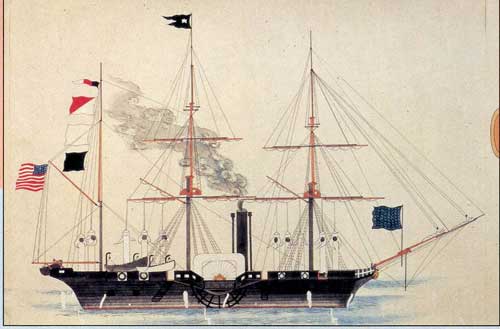
Photo: 日本財団
In 1859, they redirected everything to Yokohama — a fishing village across the bay with 600 residents and no infrastructure. The marshland was drained and filled. A grid was surveyed. Wharves were built. The foreign settlement occupied 25 acres near the water. The Japanese commercial district, Kannai, was laid out adjacent. Kanagawa became a quiet post town again. Yokohama became the interface.
This was not an accident. Yokohama was chosen because it could be controlled as an enclave — foreign presence contained, monitored, separated from the rest of Japan. But enclaves develop their own logic. By 1872, Yokohama had Japan's first railway, connecting it not to Edo but to Shinbashi, the capital's edge. By 1874, it had Japan's first modern brewery. By 1887, Japan's first electric lights. The city was supposed to be a buffer. Instead it became a prototype.
The Kanto Earthquake as Reset
Tokyo likes to describe the 1923 Great Kanto Earthquake as a shared disaster. It was not. The quake's epicenter was in Sagami Bay, southwest of Yokohama. The city took the initial shock at 11:58 a.m. on September 1. Fires broke out in Kannai within minutes. By nightfall, 80% of Yokohama's buildings were destroyed. Casualty estimates range from 20,000 to 30,000 — a higher percentage of population loss than Tokyo.
The national government moved reconstruction funds to the capital. Tokyo would be rebuilt as a modern metropolis. Yokohama would be rebuilt as a port. The distinction mattered. Tokyo received wide boulevards, parks, and firebreaks. Yokohama received berths, warehouses, and customs facilities. The message was clear: Tokyo is the city. Yokohama is the service.
But Yokohama rebuilt itself differently. The foreign settlement, legally dissolved in 1899, had left behind a grid structure that survived the quake better than Tokyo's organic tangle. The city adopted it. Straight streets. Predictable blocks. Consistent setbacks. This was not aesthetic preference. It was a recognition that the city's role — as trade hub, as immigrant entry point, as legal and


