City Guide of Yokohama

A City You Might Already Know
Yokohama shares a specific lineage with other Pacific Rim cities.
It is not an inland capital defined by bureaucracy. It is a port city defined by trade, wind, and open horizons. If the name "Yokohama" is unfamiliar, it may help to think of it through three global archetypes you might already know.
The Geography: San Francisco
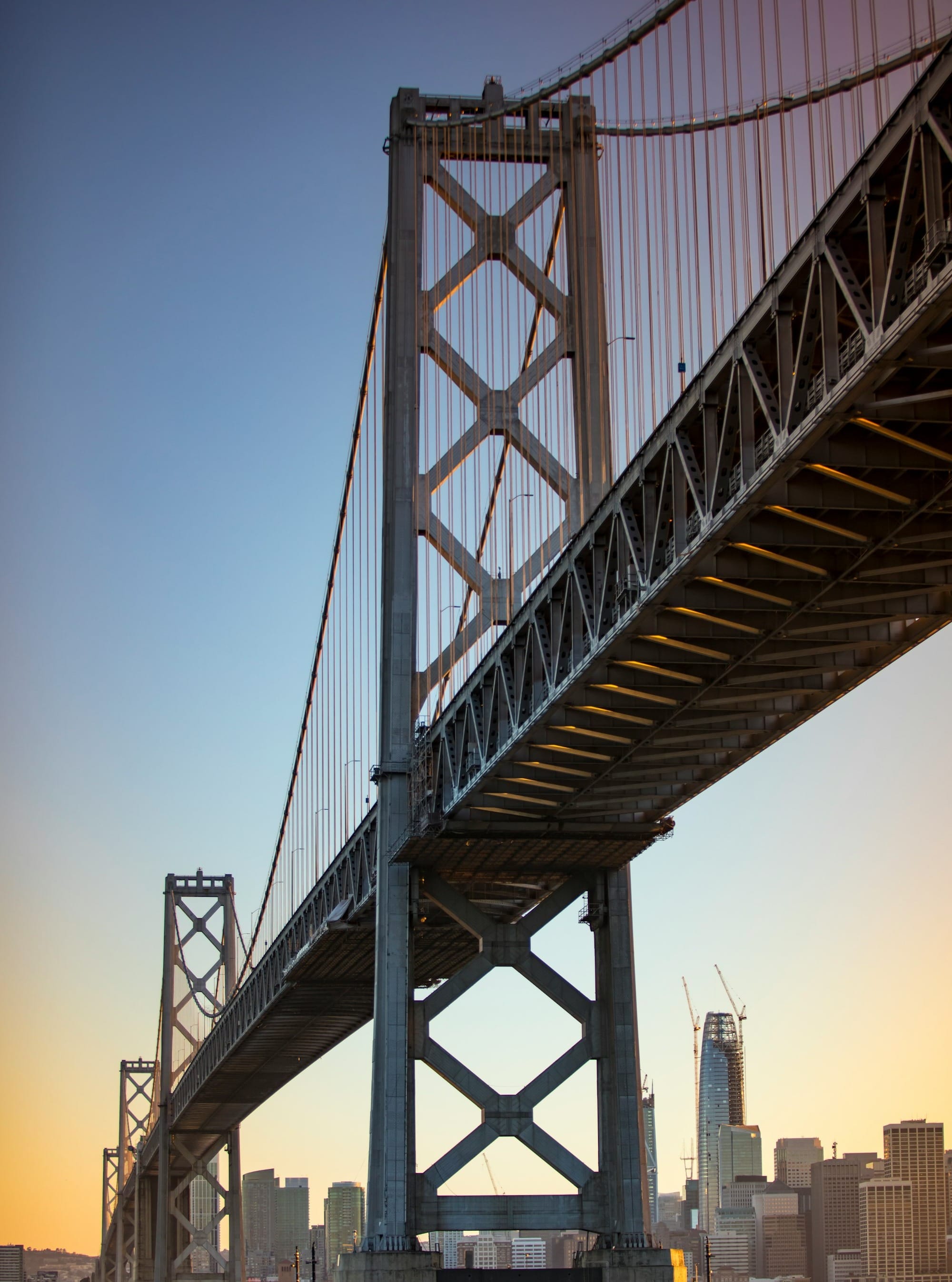
Like San Francisco, Yokohama is built on hills that roll down to a deep-water bay.
Both cities served as their country's historic gateway to the world. Both host a world-class Chinatown, a heritage of red-brick architecture, and a "Bluff" district—here called Yamate—where international culture first took root. Stand on the hillside above the harbor, and the parallels are hard to miss.
The difference is context. Yokohama offers the views and the cosmopolitan history, but wrapped in Japanese infrastructure. The streets are clean. The trains run to the second. The night is safe to walk alone. The romance of a port city, without the friction that often accompanies it elsewhere.
The Lifestyle: Sydney

In many cities, the port is industrial—somewhere you pass through, not somewhere you linger. In Yokohama, as in Sydney, the waterfront is the city's living room.
The promenade from Yamashita Park to Minato Mirai functions much like Circular Quay or Darling Harbour. A continuous stage for dining, festivals, and active life. The water is not decoration. It is used—for triathlons, for paddleboarding, for morning runs along the harbor edge.
The difference is scale. You do not need a ferry to cross the bay. You can walk the entire waterfront crescent in under an hour. The lifestyle is similar, but the distances are compressed.
The Relationship: Brooklyn

Perhaps the most useful comparison is not geography, but positioning.
If Tokyo is Manhattan—vertical, intense, business-driven, expensive—then Yokohama is Brooklyn. The counterweight. The place where creatives, families, and artisans move when they want space to breathe. It has its own craft beer culture, its own pride, and a view of the skyline rather than a life trapped inside it.
The difference is autonomy. Unlike a borough, Yokohama is a fully independent city—Japan's second largest, in fact—with its own bullet train station, its own stadiums, its own government. It connects to Tokyo, but it does not depend on it. The relationship is one of choice, not necessity.
The Practical Reality
To understand Yokohama is to understand its scale.
This is not a suburb. It is a city of 3.77 million people—larger than Berlin, Madrid, or Toronto. While our essays focus on the texture of daily life, this section covers the logistics: how to get here, what it costs, who lives here, and which neighborhood might fit your rhythm.
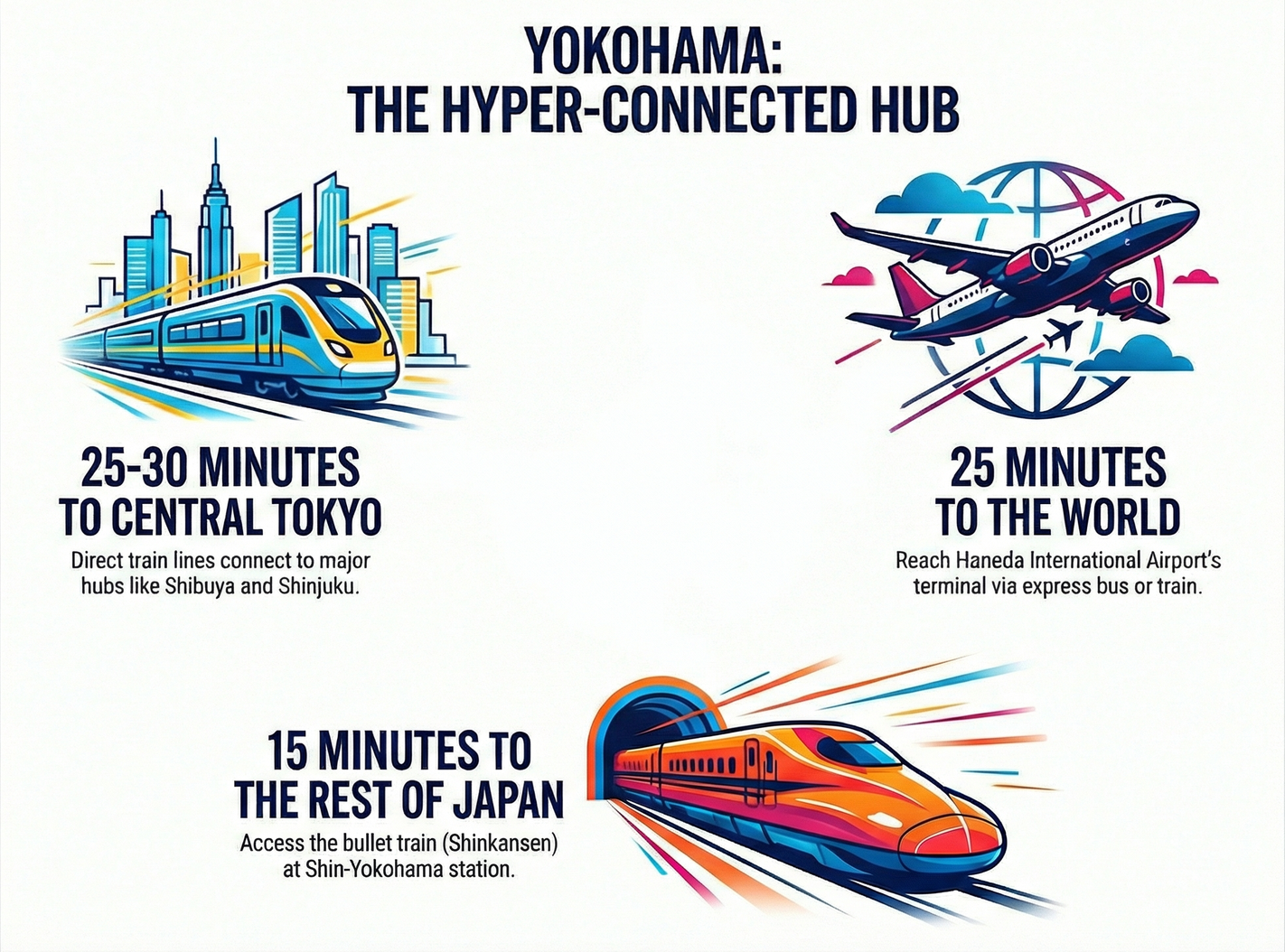
Connectivity: The 30-Minute Radius
Yokohama is autonomous, but hyper-connected. The Bay Area functions as a strategic hub—access to the capital without the need to live inside it.
To Tokyo: 25–30 minutes. Direct train lines connect Yokohama Station to Shibuya, Shinjuku, and Tokyo Station. The commute is real, but it is not punishing.
To the World: 25 minutes to Haneda Airport. This is the hidden advantage of living here. An express bus or train puts you at an international terminal in less than half an hour. For those who travel frequently, the calculus changes.
To the rest of Japan: 15 minutes to Shin-Yokohama, the bullet train station. Kyoto, Osaka, Hiroshima—the country opens up from here.
The result: you are never trapped. The city is designed for movement, inward and outward.
Cost: Value, Not Just Price
Tokyo commands the highest rent premiums in Japan. Yokohama offers a different equation—not cheap, but significantly more value per square meter.
Rent in the Yokohama Bay Area generally runs 20% to 30% lower than comparable central Tokyo districts. But the real difference is what that money buys. In Tokyo, your rent pays for location. In Yokohama, the same budget often secures a newer building, a balcony with a harbor view, or walking distance to a park.
Rough estimates for the Bay Area:
- 1LDK (40–50㎡): ¥130,000 – ¥180,000 / month
- 2LDK (55–70㎡): ¥200,000 – ¥300,000 / month
- High-end towers: ¥350,000+ / month
These are not precise figures—the market shifts, buildings vary, timing matters. But the pattern holds: comparable quality, lower cost, more space.
Demographics: A City That Has Always Faced Outward
Yokohama has been Japan's front door since 1859. That history shows up in who lives here today.
In Naka Ward—the heart of the Bay Area, covering Kannai, Chinatown, and Honmoku—foreign residents make up over 10% of the population. This is not a temporary expat bubble. It is a layered community of long-term residents from China, Korea, Southeast Asia, and the West. The diversity is not curated or recent. It is generational.
The feel is different from Tokyo's international districts. Less transient. People move here to settle, not to pass through. Neighborhoods have fabric. Faces become familiar. The city is cosmopolitan, but it is also rooted.
The Neighborhoods: Finding Your Zone
The Bay Area is not a single place. It is a collection of distinct villages, each with its own rhythm.
Minato Mirai — The Future, The Clean
Wide sidewalks. Glass towers. Water on three sides. This is the district that appears on postcards—organized, spacious, intentionally modern.
Best for: Runners who want uninterrupted paths. Families who prioritize safety and parks. Those who find comfort in the new.
The feel: Polished. Efficient. A city that has been planned, not accumulated.
Bashamichi & Kannai — The History, The Brick
Tree-lined boulevards. European-influenced architecture. The old administrative heart of the port city. This is where Yokohama's 19th-century ambitions are still visible in stone and brick.
Best for: Craft beer crawls. Cafe afternoons. Architecture photography. Those who want to feel history underfoot.
The feel: Classic. Layered. A district that rewards slow walking.
Noge & Isezakicho — The Deep, The Real
Narrow streets. Neon signs. Izakayas stacked on top of each other. This is the unfiltered side of the city—chaotic, loud, alive in ways the waterfront is not.
Best for: Late-night eating. Jazz bars. Asian grocery runs. Those who want texture over polish.
The feel: Unvarnished. Energetic. A reminder that Yokohama is not just views and promenades.
Yamate & Honmoku — The Green, The Quiet
Hillside streets. Old Western-style houses. Gardens visible through gates. Historically the district where foreign residents first settled, and still carrying that atmosphere today.
Best for: Families with children in international schools. Those who want a garden. Anyone who values quiet over convenience.
The feel: Residential. Leafy. A slower tempo, a few degrees removed from the harbor bustle.
Choosing
There is no correct answer. The right neighborhood depends on what you need from a city—and what you are willing to trade.
If you want energy, head to Noge. If you want calm, climb to Yamate. If you want the feeling of living in the future, Minato Mirai delivers. If you want the weight of history, Kannai has it.
The Bay Area is small enough that you can sample all of them in an afternoon. Walk through. Sit in a cafe. See what resonates.
The city does not demand a decision. It simply offers options.